Listen to Faulkner lecture on writing, & read from “The Town.”
Category Archives: what’s new
The Rumpus Interview With Jennifer Egan
I interviewed Jennifer Egan for the great literary online magazine The Rumpus. You can read it in full here, but here’s a teaser:
Look at a book like Tristram Shandy , which is so crazily experimental in a way we still have yet to match. There’s such a desire not to just say: this happened and then this happened and then this happened. The tension is between the incremental and inexorable passage of time and the leaping, stuttering quality of consciousness. The two do not match up. One result of that is that time is passing gradually, but we experience its effect as very sudden. Our perception of time is full of all these gaps. That really interests me, and I think it informed the fragmented structure of the book. I wanted to capture as many shocking discoveries of time having passed as possible, which is difficult to do if you’re just moving forward in time.
20 Under 40


World Cup Reading
- Njabulo Ndebele.
- J. M. Coetzee
- Zoe Wicomb
- Ceridwen Dovey
- Niq Mhlongo
- Nadine Gordimer
- Lisa Fugard
- K. Sello Duiker
- Deon Meyer
- Zakes Mda
- Phaswane Mpe
- Rozena Maart
Touching the Stanley Cup
One of my earliest sports-related memories, apart from being forcibly drowned by the summer camp bus driver/swim coach, was going to a Blackhawks game at the old Chicago Stadium, pre-MJ. I was maybe six, too lanky to play, didn’t know how to skate anyway. Plus I was already permanently embarrassed due to a bad stutter, which nearly kept me bedroom-bound. The first game Dad took me to, during Denis Savard‘s first stint with the Hawks, was an eye-opening experience: I was doused with my first Budweiser, ate my first Vienna Beef Chicago-style hot dog (Mom’s dogs were slathered in nothing more than ketchup), and I almost caught my first puck. Or Dad did. He’s pretty adamant he was the one responsible for reaching up and knocking it down before it peeled off into a deeper row, and now that I think about it he’s probably right. But, in my youthful nimbleness, I was the one who darted between foreign legs and picked the puck up. We still have it, all these years later.
Last night, after raucous all-night celebrations on the streets of Chicago, my brother got to touch the Stanley Cup. Which I think is illegal, or frowned upon.But that’s the way we do it in Chicago: there ain’t nothin’ on a pedestal, not even the stinkin’ Stanley Cup. As it well should be in what’s supposed to be this democracy of ours.


Short short on Monkeybicycle
A short short story I wrote, called “Her Hair,” was recently published by the great fiction Web site Monkeybicycle.
‘This Is Thomas Pynchon Speaking’
Once-waterboarded Christopher Hitchens writes in his memoir Hitch-22 of meeting Ian McEwan (through–who else?–Martin Amis). According to Hitch, McEwan “seemed at first to possess some of the same vaguely unsettling qualities as his tales. He never raised his voice, surveyed the world in a very level and almost affectless fashion through moon-shaped granny glasses [!!!], wore his hair in bangs, was rail-thin, showed an interest in what Martin used to call ‘hippie-ish’ pursuits, and when I met him was choosing to live on the fringes of the then weed-infested ‘frontline’ black ghetto in Brixton.”
Far be it from me to be an expert on “granny glasses,” but Hitch may have been onto something (see right, although personally I was hoping for a thicker rim).

Presently, as if in a certain McEwan novel about love and stalking, Hitch received a phone call from Thomas Pynchon. I don’t know about you, but I have long imagined this exact moment. I’m sitting in the basement rec room, a budding 17-year-old wannabe writer, reading Gravity’s Rainbow while my brothers play Nintendo in the next room. The phone rings. Mom calls down. “Who is it?” I yell up to her over the mechanical clatter of Super Mario Brothers. “Don’t know. Funny accent.” Mildly trepidatious it might be my soccer coach calling to say practice has been pushed up to 4 a.m. tomorrow, I pick up and am greeted by… Now, in my teenage fantasy, he says, “Hey, man, Tom here. You know, Tom Pynchon. What’s up, man?” Throw in a stutter for dramatic effect. Static on the line because he’s calling from an undisclosed location in Pennsyltucky (this was before Mason & Dixon, part of the research of which legendarily included the author walking the entire Mason-Dixon line). But never did I imagine he’d come right out and say, as Hitch recalls,
“This is Thomas Pynchon speaking.”
Because, um, Pynchon? Wouldn’t he be a bit more…hesitant? Guarded? Maybe mumble something along the lines of “Oh, hey, hi, um…” and not come right out and brashly declare “This is Thomas Pynchon speaking?” Although, with this knowledge, go back and listen to Pynchon’s actual voice (the two Simpsons appearances, here and here; the Inherent Vice book trailer), and yeah, OK, I can picture it. Especially with the mild Long Island accent.
The intrigue builds as Hitch writes on:
“I am glad that I did not say what I first thought of saying, because he was soon enough able to demonstrate that it was he, and that a mutual friend (make that a common friend) named Ian McEwan had suggested that he call. Larry Kramer’s ultra-homosexual effort Faggots had been seized by the British Customs and Excise, and all the impounded copies were in danger of being destroyed. Mr. Pynchon was somewhere in England and was mightily distressed by this. What could be done? Could I raise an outcry, as Pynchon had been assured by Ian I could? I told him that one could protest hoarsely and long but that Britain had no law protecting free speech or forbidding state censorship. We chatted a bit longer, I artlessly offered to call him back, and he laughingly declined this transparent try-on and faded back into the world where only McEwan could find him.”
I don’t know about you, but while I pine for the Pynchon biography, what is emerging, of late, is a literary love affair friendship between Pynchon and McEwan that rivals another famous allegedly homosexual literary coupling, between Melville and Hawthorne. The mind reels what revolutionary words are whispered late at night under the covers…
David Mitchell
It might be my own childhood stammer–which, since these things never fully go away, creeps into my mid-adulthood–but I’ve always believed there is a deeply ingrained connection between writing and stammering. Not every stammerer grows up to become a writer, but certainly there has to be a link between the agonizing isolation of the stutterer and the self-inflicted exile of the writer, right? In my own case, I guess my stutter placed special emphasis on language and the making of language. What I couldn’t say out loud I could write, silently, in my own head, and, later, on paper, in glorious, fluent blocks of prose. Or so I thought at the time.
Stammers never fully go away, of course, and there are times I find myself unable to speak–and then, when I do, it all rushes out in muddled, mile-a-minute, nonsensical bursts. Similarly, there are times I feel like I am unable to write, or rather, I write and write and then rewrite and rewrite and rewrite until the prose is entirely different, if not necessarily better. At times, this leads to clarity; other times, confusion. There are so many ways to say the most simple feeling, emotion, thought, anxiety. This is the agony of the stammerer. How best to say it?
Among contemporary novelists, there are a few great former-stammerers–David Foster Wallace comes to mind–and I’m sure there are a fair number of dissertations that will be written on DFW’s speech impediment and the labyrinthine hesitancy of his prose. But among living novelist-stammerers, none, I think, are as consumed with language and the fracturing of language as David Mitchell.
For the record-keepers out there, other notable writer-stammerers include:
- Lewis Carroll
- Machado de Assis
- Henry James
- Margaret Drabble
- William Somerset Maugham
- Edward Hoagland
- John Updike
- David Foster Wallace
The World According To DFW
The Harry Ransom Center at the University of Texas at Austin has been on a spending spree for years, purchasing the papers of literary titans like James Agee, Norman Mailer, and Don DeLillo (among innumerable others).

Now, they’ve added David Foster Wallace’s sprawling scribblings to their collection, much of it available online. Highlights include a handwritten early draft of Infinite Jest, 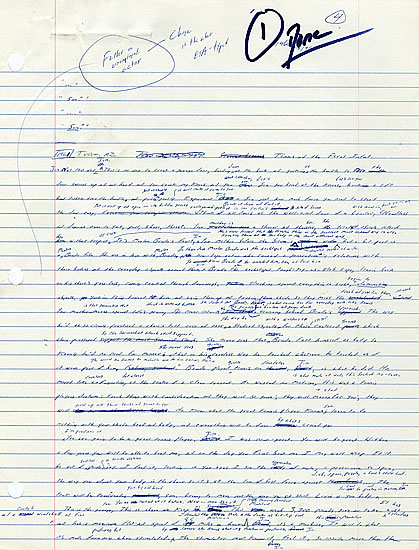 books from Wallace’s personal collection, featuring his chicken-scratch marginalia, a dictionary with words Wallace circled–which probably came in handy during the composing of his landmark essay “Present Tense: Democracy, English, and the Wars Over Usage,” first published in the April 2001 Harper’s. The manuscript of the elusive Pale King is there, as well.
Here’s Wallace’s longtime agent, Bonnie Nadell, on how the DFW papers ended up at UT-Austin:

Organizing David Wallace’s papers for an archive was not a task I would wish on many people. Some writers leave their papers organized, boxed, and with careful markers, David left his work in a dark, cold garage filled with spiders and in no order whatsoever. His wife and I took plastic bins and cardboard boxes and desk drawers and created an order out of chaos, putting manuscripts for each book together and writing labels in magic markers.

But what scholars and readers will find fascinating I think is that as messy as David was with how he kept his work, the actual writing is painstakingly careful. For each draft of a story or essay there are levels of edits marked in different colored ink, repeated word changes until he found the perfect word for each sentence, and notes to himself about how to sharpen a phrase until it met his exacting eye. Having represented David from the beginning of his writing career, I know there were people who felt David was too much of a “look ma no hands” kind of writer, fast and clever and undisciplined. Yet anyone reading through his notes to himself will see how scrupulous they are. How a character’s name was gone over and over until it became the right one. How David looked through his dictionaries making notes, writing phrases of dialogue in his notebooks, and his excitement in discovering a wild new word to use.
I’m So Sick Of Goodbyes, Mark Linkous
Mark Linkous took his own life yesterday. I interviewed Mark in 2001, right before It’s A Wonderful Life came out. Stupid me, I couldn’t get the recorder to work, which seems peculiarly appropriate. What I remember is here.
